ELSS Mutual Fund
ELSS Mutual Funds, also known as Equity Linked Savings Schemes, are one of the most popular tax-saving investment options for both Indian residents and NRIs. Besides helping you save up to Rs. 1.5 lakh in taxes under Section 80C, they also offer the potential for long-term growth through equity investments. So, if you’re looking for an investment that works double duty, saving taxes and building wealth, keep reading.read more

4.7/5
44,602
 Reviews
Central Bank UAE Registration No.: - 123
Insurance Partners
Trusted Customers
Policies Sold

Get AED 1 Million*






Best Investment Plans in UAE
Some of the best Investment quotes in UAE & Dubai are:




Best ELSS Funds to Consider in 2026
Here are some of the best ELSS funds in 2026—
- SBI Long-Term Equity – Excellent 10‑year track record, no exit load.
- DSP ELSS Tax Saver – Strong historical performance and portfolio diversification.
- Bandhan ELSS Tax Saver Fund – High returns in a conservative package.
- Quant ELSS Tax Saver – Active management, top-tier returns.
- Aditya Birla Sun Life ELSS Tax Saver Fund -
Additional top picks:
- ICICI Prudential ELSS Tax Saver Fund – Good for moderate risk; equity + debt balance
- Mirae Asset ELSS Tax Saver Fund – Large-cap stability
- Parag Parikh ELSS Tax Saver Fund – Focused on value investing
Don’t let your savings sit idle; make them work for youExplore ELSS funds and SIP options tailored for UAE residents. Start your plan on Policybazaar.ae. It takes less than 5 minutes. |
|---|

How ELSS Funds for NRI Work?
Here how ELSS mutual funds work —
- Fund Structure: At least 80% invested in equity and equity-related securities, plus a small debt portion.
- Tax Benefits: Up to Rs. 1.5 lakh deduction under Section 80C.
- Lock-in Period: Mandatory 3-year lock-in ensures disciplined investing.
- Market-linked returns: Offers higher return potential compared to traditional tax-saving instruments like PPF or FD.
- NRI-friendly: NRIs can invest and claim tax deductions (if they file income tax in India).
Investing Methods: SIP vs Lump Sum
- SIP (Systematic Investment Plan): Great for beginners and market-timers. It averages out purchase costs and reduces the risk of market volatility.
- Lump Sum: Suitable if markets are down and you’re confident in future growth, but carries higher short-term risk.
Key Features of ELSS Mutual Funds
|
Feature |
Why It Matters |
|---|---|
|
Dual Benefit |
Tax deduction + equity growth: a rare combo in the investment world |
|
Beats Inflation |
Equity exposure helps generate returns above inflation rates |
|
Expert Management |
Fund managers leverage research and strategy for optimal returns |
|
Shortest Lock-in |
Only 3 years, compared to 5–15 years for other instruments |

Why Should You Invest in ELSS Mutual Funds?
If your goal is to grow long-term wealth, ELSS (Equity-Linked Savings Scheme) funds are one of the most efficient options available under the old tax regime. These mutual funds invest predominantly in equities, offering a dual benefit of tax deductions and market-linked returns.
1️⃣ Dual Advantage: Tax Savings + Wealth Creation
ELSS offers a powerful combination, reducing your taxable income while building a long-term investment portfolio.
In short, ELSS mutual funds help you save tax today (if you are an NRI investing in India) while building wealth for tomorrow, a unique advantage compared to most tax-saving schemes.
2️⃣ Shortest Lock-In: Just 3 Years
Liquidity matters. ELSS stands out by offering one of the lowest lock-ins among tax-saving products, giving investors more flexibility.
|
Tax-Saving Investment |
Lock-In Period |
|---|---|
|
ELSS Funds |
3 years |
|
PPF |
15 years |
|
NSC |
5 years |
|
Tax-Saving FD |
5 years |
|
EPF |
Till retirement |
After 3 years, you may either redeem your units or stay invested for long-term growth, making ELSS suitable for long-term planning without sacrificing liquidity.
3️⃣ Flexible Investment Modes: SIP & Lump Sum
ELSS accommodates all types of investors, those who prefer discipline and those who prefer timing.
|
Investment Mode |
Best For |
Benefits |
|---|---|---|
|
SIP (Systematic Investment Plan) |
Monthly savers, first-time investors |
Rupee-cost averaging, discipline, and gradual wealth accumulation |
|
Lump Sum |
Investors with surplus funds |
Potential to benefit if markets are undervalued at entry |
Tip: SIPs smooth out volatility and encourage consistency, making ELSS less sensitive to market timing—especially useful for beginners.
4️⃣ Higher Returns Than Most Traditional 80C Options
While returns are not guaranteed, ELSS mutual funds historically deliver stronger long-term performance, backed by equity exposure.
|
Tax-Saving Option |
Expected Annual Returns |
|---|---|
|
ELSS Funds |
~10–12%+ (market-linked) |
|
PPF |
7–8% |
|
NSC |
6–8% |
|
Tax-Saving FD |
6–7% |
|
EPF |
8.15% (FY 2023-24) |
Bottom line: If your priority is wealth creation alongside tax savings, ELSS is among the strongest options.
5️⃣ Cost-Effective: No Entry or Exit Load
Most ELSS funds do not charge entry or exit loads, reducing cost leakage and maximising net returns.
|
Investment Type |
Entry Load |
Exit Load |
|---|---|---|
|
ELSS Funds |
No |
No |
|
Regular Equity Funds |
Sometimes |
If withdrawn early |
|
Tax-Saving FD |
No |
No |
|
ULIPs |
Yes |
Yes |
6️⃣ No Cap on Investment Amount
Although Section 80C allows tax benefits only up to ₹1.5 lakh, there is no upper limit on investing more into ELSS (if you are an NRI investing in India). Many long-term wealth-focused investors continue SIPs beyond the tax benefit for sustained equity exposure.
7️⃣ Compounding Over Time: Real Corpus Growth Example
Let’s assume you invest AED 5,000 per month via SIP for 10 years, targeting ~12% returns.
|
Timeframe |
Total Invested |
Estimated Wealth Gain |
Approx. Value |
|---|---|---|---|
|
1 year |
AED 60,000 |
AED 3,600 |
AED 63,600 |
|
5 years |
AED 3,00,000 |
~AED 1,12,700 |
~AED 4,12,700 |
|
10 years |
AED 6,00,000 |
~AED 5,32,700 |
~AED 11,32,700 |
Your investment nearly doubles, thanks to the joint power of compounding and equity growth.
Best Time to Invest in ELSS Mutual Funds
Most investors rush to invest in March merely for tax benefits, but spacing investments out is more effective.
|
Strategy |
Why It Works |
|---|---|
|
Start early in the year |
More time in the market = greater compounding |
|
Use SIPs |
Reduces timing risk and builds discipline |
|
Stay invested 5+ years |
Allows equities to iron out volatility and perform |
Ideal approach: Invest regularly via SIPs and stay invested beyond the lock-in to maximise wealth building
Did You Know?The Sharpe ratio helps you understand how much extra return you're getting for the risk you’re taking. It shows how much your investment earns over the risk-free rate (like a government bond), for every unit of risk taken (with risk measured using standard deviation). A higher Sharpe ratio means you're getting better returns for the risk you're taking, which is a sign of a well-performing investment. |
|---|
4. Expense Ratio
This is the annual fee a fund charges as a percentage of your investment.
- A high expense ratio can eat into your returns over time.
- However, a slightly higher cost may be justified if the fund consistently delivers superior performance. Balance cost with quality.
5. Risk Profile Match
Choose a fund that aligns with your risk tolerance.
- If market ups and downs make you anxious, prefer large-cap, low-risk ELSS funds.
- If you can stay invested longer and stomach volatility, you may benefit from mid/small-cap focused ELSS.

Is ELSS risk-free?
ELSS invests primarily in equities, so the value fluctuates with the market. However, staying invested for 5–7+ years generally reduces volatility and improves return potential.
Are ELSS funds available for NRIs?
Yes, ELSS funds for NRI are eligible. NRIs can invest via NRE/NRO/FCNR accounts. ELSS gives NRIs the same benefits: equity growth and tax savings under Section 80C via PAN & valid KYC.
How to calculate ELSS returns?
You can use the formula FV = C × (1 + r)^t to calculate your return or an online ELSS calculator.
Can I redeem ELSS after 3 years?
Yes. After completing the lock-in period, you can redeem your funds anytime.
What’s ELSS equity exposure?
ELSS mutual funds offer minimum 80% exposure in equity, with diversification across sectors and market caps.
Can I withdraw my ELSS funds investment during the lock-in period?
No, once invested, you can not withdraw your investment during the lock-in period of 3 years. You will need to wait until the period expires.
Can I withdraw my ELSS investment during the lock-in period?
No. An ELSS mutual fund does not allow partial or full withdrawal before 3 years. You must stay invested until the lock-in ends.
What’s the equity exposure in ELSS funds?
ELSS mutual funds invest at least 80% of their portfolio in equities, diversified across sectors and market caps to balance growth and risk.
Can I withdraw after every 3 years?
Yes. ELSS follows a “3-year lock-in per investment” rule. Each SIP instalment or lump-sum investment becomes redeemable exactly 3 years from its investment date.
What do ELSS funds invest in?
ELSS mutual funds primarily invest in equities, often large-cap dominant, with allocations to mid and small caps for higher growth potential.
How long should I stay invested in ELSS?
While 3 years is the lock-in, a minimum 5-year horizon is recommended for meaningful compounding and smoother returns. Many investors stay invested for 7–10 years to maximise growth.
Are ELSS returns better than fixed deposits (FDs)?
Historically, yes. ELSS has delivered higher inflation-adjusted returns than FDs. However, returns are market-linked and not guaranteed, unlike fixed deposit interest.

More From Investment
- Recent Articles
- Popular Articles
- Last Updated : 18 Sep 2026What Is Investment? Meaning, Types & How It WorksWhat is investment? Learn the meaning of investment, how it works, common investment types, benefits, risks and how to get started.
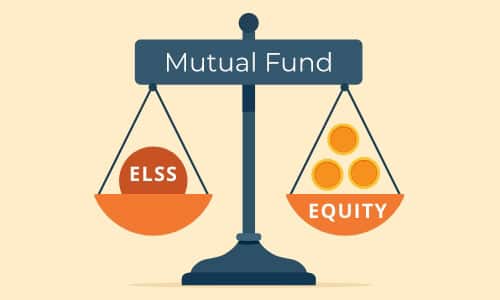 Last Updated : 18 Jun 2026ELSS vs Equity Mutual Funds: Key Differences, Benefits & Which is BetterCompare ELSS vs equity mutual funds. Understand the difference between ELSS and equity mutual fund investments, tax benefits, lock-in periods, liquidity, returns, and which option suits your financial goals better.
 Last Updated : 18 Jun 2026SGB vs Mutual Funds: Which Investment Option is Better for UAE Expats in 2026Compare SGB vs mutual funds in 2026 for UAE expats and residents. Understand sovereign gold bonds vs mutual funds, returns, risks, taxation, liquidity, and which investment option suits your financial goals better.
 Last Updated : 18 Jun 2026Best SBI Investment Plans for 3 Years in 2026 for UAE NRIsDiscover the best SBI investment plans for 3 years in 2026 for UAE NRIs and expats. Compare SBI SIP plans, mutual funds, FDs, debt funds, and hybrid funds for stable returns and long-term growth.
 Last Updated : 04 May 2026Mutual Fund Interest Rates & Returns Explained | Average & High Return Mutual FundsUnderstand mutual fund interest rates and what drives returns. Learn about average mutual fund returns, high return mutual funds, and how NRIs can maximise long-term growth.
 Last Updated : 30 Apr 2026How to Start Investing at 25 with ₹30,000 Salary | Best Investment Plan for 25 Year OldLearn how to start investing at 25 with a ₹30,000 salary. Discover the best investment plan for 25 year old, SIP strategies, and where to invest for long-term growth from the UAE.

 Last Updated : 07 Aug 202610 Best Mutual Funds in UAE to Invest to Right NowDiscover the top 10 best mutual funds in UAE and Dubai for 2026. Compare performance, features, and find the best mutual fund investment in UAE for your goals.
 Last Updated : 08 Sep 2026Top 10 Best Trading Platforms in UAE, Dubai (2026)Explore the 10 best online trading platforms in the UAE, including eToro, Plus500, and Interactive Brokers. Learn about their features, benefits, and safety measures for both beginners and seasoned traders.
 Last Updated : 08 Sep 202615 Best Short Monthly Investment Plan in UAE with High ReturnsRecurring Deposits (RDs) are among the best monthly investment plans in UAE for those who prefer to save consistently over time.
 Last Updated : 02 Jul 2026Top 10 Best gold Shops to buy gold in Dubai, UAEHere we have listed down the top 10 gold shops to buy gold in the UAE that has a great reputation in the market and sell pure quality of gold.
 Last Updated : 10 Dec 2025 How to Invest AED 10,000 in UAE to Multiply Your Money?Explore the best investment plans in UAE's thriving market to invest your AED 10000 to help you turn your savings into a profitable venture.
- Last Updated : 08 Jul 2026Gold Rate in Abu Dhabi – 22K & 24K Gold Price in AEDCheck gold rate in Abu Dhabi for 18K, 21K, 22K, and 24K gold. View real-time gold prices per gram, historical trends, price charts, and expert insights before buying gold in Abu Dhabi.




 Reviews