Equity Mutual Funds in UAE: Meaning, Returns, Risks & How to Invest
Equity mutual funds in the UAE have become a go-to investment option for both residents and expats. These funds are ideal for those who want long-term wealth creation with global diversification. With no tax on capital gains or dividends for individuals, UAE-based investors can grow their money more efficiently compared to many other markets. read more

4.7/5
44,602
 Reviews
Central Bank UAE Registration No.: - 123
Insurance Partners
Trusted Customers
Policies Sold

Get AED 1 Million*






Best Investment Plans in UAE
Some of the best Investment quotes in UAE & Dubai are:




Equity funds suit investors who —
- Want exposure to stock markets without picking individual stocks
- Seek inflation-beating, long-term returns
- Can handle short-term fluctuations for potentially higher long-term gains
Example:
Let’s say you invest AED 2,000 monthly in a balanced equity mutual fund for 10 years. Assuming a 9% annual return, your total investment of AED 240,000 could grow to around AED 310,000–350,000 depending on market conditions.
This long-term compounding effect is why equity mutual funds remain popular among residents for investment in UAE to build wealth for retirement or children’s education.
Why Do UAE Residents Prefer Equity Mutual Funds?
✔ Potential for higher long-term returns
Equities historically outperform inflation over long periods. This makes them ideal for retirement, education planning, and wealth creation.
✔ Diversification
One fund can hold 40–200 stocks across industries, reducing the risk of single-company exposure.
✔ Professional fund management
Fund managers and analysts monitor markets, earnings, global trends, and valuations. This can be quite useful for investors with limited time.
✔ SIPs for disciplined investing
You can invest monthly in AED to average out market pricing and build wealth systematically.
Planning Your Child’s Education in 10–15 years?
|
|---|

Best Equity Income Funds for UAE Investors
While performance changes yearly, UAE investors commonly explore —
|
Fund Name |
Category |
Indicative Long-Term Return* |
|---|---|---|
|
ICICI Prudential Bharat 22 FOF |
Multi-Cap |
~18–22% p.a. |
|
Motilal Oswal MidCap |
Mid-Cap |
~17–21% p.a. |
|
HDFC MidCap |
Mid-Cap |
~16–20% p.a. |
|
Nippon India Multi-Cap |
Multi-Cap |
~15–19% p.a. |
|
Quant Flexi Cap |
Flexi-Cap |
~18–22% p.a. |
*Returns are indicative based on historical performance. Future returns are not guaranteed.
For NRIs, ELSS funds may be considered when searching for the best equity mutual funds to invest in 2026, depending on tax residency.

How to Choose the Best Equity Mutual Funds in the UAE?
Before selecting a fund, assess —
- Time horizon: Aim for 5–10 years minimum
- Risk profile: Conservative, moderate, or aggressive
- Return expectations: Avoid chasing recent highs
- Cost (expense ratio): Lower fees help long term
- Fund consistency: Stable performance > short-term spikes
Example:
If your goal is retirement in 12 years, prioritise multi-cap, large & mid-cap, and global equity funds over short-term thematic plays.
Expected Returns: A Realistic View
Returns depend on markets, but historically —
- Globally diversified equity funds returned 6–10%+ over the long term
- Mid/small-cap funds may return more but fluctuate sharply
|
Time Horizon |
Typical Equity Expectation |
|---|---|
|
1 year |
Negative to high — unpredictable |
|
3 years |
Moderate returns with volatility |
|
5–10+ years |
Historically higher than inflation & fixed income |
Top equity mutual funds often push investors toward short-term winners, but experienced UAE investors prioritise rolling returns and long-term consistency.

How Can UAE Residents Invest in Equity Mutual Funds?
- Define your goal (ex: AED 1.5M for retirement)
- Choose a regulated UAE platform (banks, robo-advisors, distributors)
- Complete KYC using Emirates ID / residence visa
- Begin SIPs (minimums vary from AED 100–1,000+) or lump sums
- Review performance annually, and avoid reacting to weekly market moves
This is how top equity mutual funds help build wealth gradually.
Pro-tip: Setting up an AED-based SIP helps avoid exchange-rate volatility when investing monthly.
Common Mistakes UAE Investors Should Avoid
Successful investors stay invested through cycles, while avoiding these mistakes —
- Chasing the latest top-performer list
- Ignoring currency exposure risks
- Investing aggressively without emergency funds
- Relying on unlicensed advisors
- Selling during market dips
Final Thought: Are Equity Mutual Funds Right for You?
If your goal is long-term wealth creation, and you can stay invested through ups and downs, equity mutual funds are one of the most effective ways to grow money in the UAE. With AED SIPs, global diversification, and tax-efficient returns, they offer a structured path toward financial independence.
They are not risk-free. But with patience and consistency, they remain among the top mutual funds for building long-term wealth from the UAE.
Start Investing Smarter from the UAE
|
|---|
FAQs on Top Equity Mutual Funds
Are equity mutual funds halal in the UAE?
Equity funds are halal only when structured as Sharia-compliant funds, i.e. when they follow Islamic investment screens and principles. Conventional equity funds may invest in prohibited sectors and are not considered halal.
Can expats invest in equity mutual funds in Dubai and other emirates?
Yes, expats with valid UAE residency and a local bank account can invest through banks, licensed brokers, and regulated investment platforms. Just ensure you are aware of tax or reporting rules in your home country.
How are mutual fund returns taxed in the UAE?
Individual investors generally pay no local tax on mutual fund capital gains or dividends in the UAE. However, foreign tax obligations may still apply depending on where the investments are made and your residency status.
What is the minimum amount to start SIP in the UAE?
Minimum SIP amounts vary by fund and platform. Generally, many UAE providers allow monthly investments starting from just a few hundred dirhams. Some international funds may require higher minimum commitments.
Should UAE-based NRIs invest in Indian equity mutual funds or global funds from the UAE?
Both can work, but Indian funds require compliance with NRE/NRO rules and Indian taxation. Many NRIs combine Indian exposure with global funds available in the UAE for better diversification.
Is it beneficial to invest in equity funds?
Yes, the best equity funds can be beneficial for long-term wealth creation as they historically deliver higher returns than fixed-income instruments. Just stay invested long enough to ride out short-term volatility.
Are equity funds high risk?
Equity funds carry market risk, making them more volatile in the short term. Long-term investing and diversification help reduce risk and improve the chances of strong returns.
Equity mutual fund vs. stocks: which is better?
Equity mutual funds are better if you want professional management and diversification without researching individual stocks. Direct equity offers more control but requires more time, knowledge, and a larger investment.
Which type of equity fund is best?
It depends on your goals and risk appetite — ELSS for tax benefits, large-cap or flexi-cap for stability, and mid/small-cap for higher growth if you can stay invested longer.
Can I invest in equity mutual funds with a low-risk appetite?
Yes, choose large-cap or balanced equity funds, which focus on stable companies and have lower volatility. SIPs also help spread risk and smooth out market fluctuations over time.
Who are equity mutual funds most suitable for?
Equity funds suit investors who are looking for long-term growth and are willing to handle short-term market ups and downs, especially those with a moderate to high-risk appetite.

More From Investment
- Recent Articles
- Popular Articles
- Last Updated : 18 Sep 2026What Is Investment? Meaning, Types & How It WorksWhat is investment? Learn the meaning of investment, how it works, common investment types, benefits, risks and how to get started.
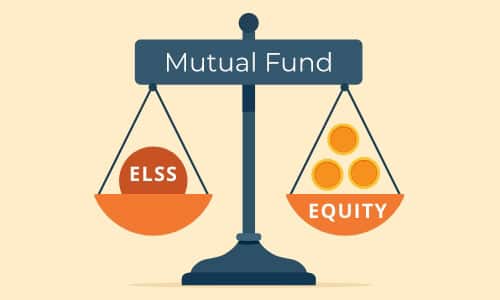 Last Updated : 18 Jun 2026ELSS vs Equity Mutual Funds: Key Differences, Benefits & Which is BetterCompare ELSS vs equity mutual funds. Understand the difference between ELSS and equity mutual fund investments, tax benefits, lock-in periods, liquidity, returns, and which option suits your financial goals better.
 Last Updated : 18 Jun 2026SGB vs Mutual Funds: Which Investment Option is Better for UAE Expats in 2026Compare SGB vs mutual funds in 2026 for UAE expats and residents. Understand sovereign gold bonds vs mutual funds, returns, risks, taxation, liquidity, and which investment option suits your financial goals better.
 Last Updated : 18 Jun 2026Best SBI Investment Plans for 3 Years in 2026 for UAE NRIsDiscover the best SBI investment plans for 3 years in 2026 for UAE NRIs and expats. Compare SBI SIP plans, mutual funds, FDs, debt funds, and hybrid funds for stable returns and long-term growth.
 Last Updated : 04 May 2026Mutual Fund Interest Rates & Returns Explained | Average & High Return Mutual FundsUnderstand mutual fund interest rates and what drives returns. Learn about average mutual fund returns, high return mutual funds, and how NRIs can maximise long-term growth.
 Last Updated : 30 Apr 2026How to Start Investing at 25 with ₹30,000 Salary | Best Investment Plan for 25 Year OldLearn how to start investing at 25 with a ₹30,000 salary. Discover the best investment plan for 25 year old, SIP strategies, and where to invest for long-term growth from the UAE.

 Last Updated : 07 Aug 202610 Best Mutual Funds in UAE to Invest to Right NowDiscover the top 10 best mutual funds in UAE and Dubai for 2026. Compare performance, features, and find the best mutual fund investment in UAE for your goals.
 Last Updated : 08 Sep 2026Top 10 Best Trading Platforms in UAE, Dubai (2026)Explore the 10 best online trading platforms in the UAE, including eToro, Plus500, and Interactive Brokers. Learn about their features, benefits, and safety measures for both beginners and seasoned traders.
 Last Updated : 08 Sep 202615 Best Short Monthly Investment Plan in UAE with High ReturnsRecurring Deposits (RDs) are among the best monthly investment plans in UAE for those who prefer to save consistently over time.
 Last Updated : 02 Jul 2026Top 10 Best gold Shops to buy gold in Dubai, UAEHere we have listed down the top 10 gold shops to buy gold in the UAE that has a great reputation in the market and sell pure quality of gold.
 Last Updated : 10 Dec 2025 How to Invest AED 10,000 in UAE to Multiply Your Money?Explore the best investment plans in UAE's thriving market to invest your AED 10000 to help you turn your savings into a profitable venture.
- Last Updated : 08 Jul 2026Gold Rate in Abu Dhabi – 22K & 24K Gold Price in AEDCheck gold rate in Abu Dhabi for 18K, 21K, 22K, and 24K gold. View real-time gold prices per gram, historical trends, price charts, and expert insights before buying gold in Abu Dhabi.




 Reviews