Endowment Policy vs Whole Life Insurance - What's the Difference
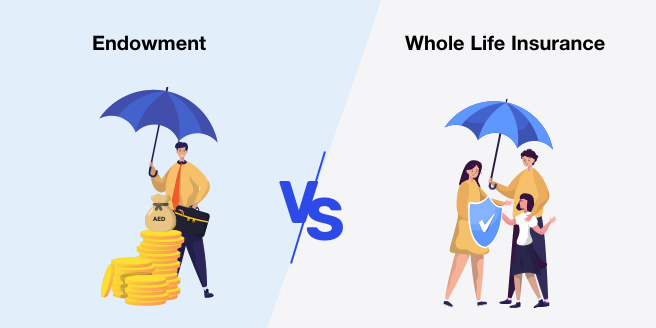
The main difference between endowment and whole life insurance is their time period. An endowment policy provides coverage for a specified period (e.g., between 10 and 25 years). If the policyholder survives, they receive a maturity benefit. Meanwhile, whole life insurance covers the insured person for their entire lifetime, typically until age 99 or 100, and a death benefit becomes payable upon the policyholder’s death. Moreover, whole life policies typically have a cash value component that can be borrowed against or surrendered for its value. Hence, an endowment plan should be purchased to achieve specific financial goals (e.g., children’s education), whereas whole life insurance should be acquired to accumulate cash value and to cover lifetime needs. Both whole life and endowment insurance are more expensive than term life insurance, and their costs depend on guaranteed benefits and policy charges.read more
4.7/5
46,158
 Reviews
Central Bank UAE Registration No.: - 123
Insurance Partners
Trusted Customers
Policies Sold

Starting @ AED 50/month*


 Qualified Policybazaar expert will assist you
 Aashima Mongia


Buy Best Life Insurance Plan in UAE
Some of the best Term Insurance quotes in UAE & Dubai are:




What is an Endowment Policy?
An endowment policy combines life insurance protection with a savings or accumulation component over a predefined policy term.
How Does it Work?
An endowment policy generally has three important components:
- Premiums: The amount you pay according to the policy schedule
- Life cover: The death benefit payable if the insured event occurs during the policy term
- Maturity benefit: The amount payable when the policy reaches its maturity date, subject to the policy terms
Some policies may include guaranteed benefits, while others may have non-guaranteed bonuses or benefits. This distinction is particularly important for investment buyers.
What is Whole Life Insurance?
Whole life insurance is designed to provide life insurance protection for the insured’s lifetime, as long as the policy is in force as per its terms. Unlike an endowment policy, it generally does not have a predetermined maturity date at which the policy automatically pays out simply because the insured is alive.
Depending on the product, whole life insurance may also build cash value over time.
This cash value can potentially offer an additional financial resource, subject to the policy’s terms, charges and applicable conditions.
Accessing Whole Life Cash Value
Investors can access the accumulated cash value of a whole life policy in a few ways:
- Policy Loans: Borrowing against the accumulated cash value at an interest rate set by the insurer, without terminating the underlying life cover
- Partial Surrender: Liquidating a portion of the cash value, which proportionally reduces the ultimate death benefit
- Full Policy Surrender: Terminating the coverage entirely in exchange for the net cash value
From a strict investment perspective, whole life insurance functions less like a growth asset. It’s more like an illiquid asset-preservation and estate-planning tool with an embedded death-benefit guarantee.

Endowment Policy vs Whole Life: What is the Main Difference?
The biggest difference is the purpose and time horizon.
An endowment policy is structured around a particular maturity date. This makes it easier to connect the policy with a financial goal.
Whole life insurance is structured around lifelong protection. Its cash value is generally a secondary feature to the permanent insurance coverage, although some buyers may also consider it as part of their long-term financial planning.
For an investment buyer, the question should therefore be:
Do I need this money at a specific point in the future, or do I want lifelong protection and long-term policy value?
Your answer can make the comparison much clearer.
Endowment vs Whole Life: Which Gives Better Returns?
This is where buyers need to be particularly careful.
It’s tempting to compare the projected maturity value of an endowment policy with the projected cash value of a whole life policy and choose the larger number. That is not enough.
You should also compare:
- Total premiums paid
- Guaranteed benefits
- Non-guaranteed benefits
- Cash value
- Maturity benefit
- Death benefit
- Surrender value
- Policy charges
- Premium payment period
- Time until the money becomes available
- Internal rate of return (IRR), where appropriate
Why Does the IRR Matter?
A policy may show a maturity value of AED 500,000, but that number alone tells you little. Suppose you have paid AED 25,000 annually for 15 years.
Your total premiums would be: AED 25,000 × 15 = AED 375,000
The relevant question is not simply whether you receive AED 500,000.
You also need to ask:
What annualised return does the cash flow represent after considering when each premium was paid and what charges were deducted?
That is where IRR can provide a more meaningful way to assess the financial outcome.
However, even IRR should not be viewed in isolation. Insurance provides protection that a conventional investment may not provide.

Endowment Policy vs Whole Life: Premium Commitment
Premium commitment can significantly affect whether a policy is suitable for you.
Endowment policies generally have a defined payment period linked to the policy term or a specified premium-payment period.
Whole life policies may also require long-term premium commitments, although structures vary considerably between products.
Before buying, ask yourself: Can I comfortably maintain these premiums if my income falls?
This matters particularly for expatriates in the UAE who may:
- Change jobs
- Leave the UAE
- Move to another country
- Start a business
- Take a career break
- Face changing family expenses
A policy that looks affordable today may become difficult to maintain several years later.
Which Policy Gives You Easier Access to Money? Whole Life Insurance vs Endowment
Don’t automatically treat either policy as a highly liquid investment.
An endowment policy is generally designed around its maturity date. Accessing money before maturity may involve surrendering the policy or using another permitted policy feature.
Whole life policies may offer cash-value access depending on their terms. However, withdrawals, loans, or surrender can affect the policy’s value and/or future benefits.
The important point is:
Don’t invest money in a long-term insurance policy if you may need most of that money in the short term.
Keep emergency savings and short-term financial goals separate from long-term insurance commitments.
Endowment vs Whole Life for Investment Buyers
If your primary concern is investment performance, do not compare these products with only their headline maturity or cash-value figures.
Look at the total financial outcome.
|
Factor |
What to Ask |
|---|---|
|
Total premiums |
How much will I pay over the full payment period? |
|
Guaranteed value |
What amount is contractually guaranteed? |
|
Projected value |
How much depends on assumptions or bonuses? |
|
IRR |
What is the annualized return based on actual cash flows? |
|
Charges |
What fees and insurance costs reduce my returns? |
|
Surrender value |
What would I receive if I exit after 3, 5, or 10 years? |
|
Death benefit |
What does my family receive if I die during the policy? |
|
Maturity |
When does the policy pay its maturity benefit? |
|
Liquidity |
How easily can I access my money? |
|
Premium commitment |
Can I afford the premiums throughout the required period? |
|
Portability |
What happens if I leave the UAE? |
|
Inflation |
Will the eventual benefit retain enough purchasing power? |
Who Should Consider an Endowment Policy?
An endowment policy may be worth considering if you:
- Have a clearly defined future financial goal
- Can commit premiums for the full intended period
- Want insurance protection alongside structured savings
- Prefer a defined maturity date
- Do not expect to need the money in the short term
- Understand the difference between guaranteed and non-guaranteed benefits
Who Should Consider Whole Life Insurance?
Whole life may be worth it if you:
- Need lifelong life insurance protection
- Have long-term family or legacy objectives
- Want to combine permanent protection with cash-value accumulation
- Can maintain a long-term premium commitment
- Do not need immediate access to most of the money
- Understand how cash value, charges and surrender values work
Who May Need to Think Twice About Either?
An endowment or whole life policy may be unsuitable if:
- You have unstable income
- You have significant high-interest debt
- You do not have an emergency fund
- You may need the money within a few years
- You cannot comfortably maintain the premiums
- You are buying solely because someone promised a high return
- You do not understand the surrender terms
- You are comparing only projected rather than guaranteed values
Long-term insurance should generally be approached as a long-term commitment, not a short-term investment.
What is the difference between an endowment policy and whole life insurance?
An endowment policy generally has a fixed term and maturity date. Whole life insurance is designed to provide lifelong protection, subject to its policy terms. Both may have savings or cash-value features depending on the product.
Is an endowment policy an investment?
An endowment policy combines insurance protection with a savings or accumulation component. It can form part of a financial plan, but don’t evaluate it like a simple investment fund. This is because it also offers insurance benefits and has policy-specific charges and conditions.
Is whole life insurance an investment?
Whole life insurance is primarily life insurance with lifelong protection. Depending on the product, it may also accumulate cash value. Buyers should evaluate both the insurance protection and financial values rather than treating it solely as an investment.
Is endowment better for short-term goals?
Endowment policies are generally designed for longer-term commitments rather than short-term savings. If you may need the money soon, check the surrender value and early-exit costs before buying.
Can I surrender an endowment policy early?
Depending on the policy terms, you may be able to surrender it early. However, the amount you receive can be significantly lower than the premiums you have paid, particularly in the early years.
Can I surrender whole life insurance?
Many whole life policies have surrender provisions, but the amount available depends on the policy’s cash value, surrender charges and other terms. Check the year-by-year surrender values before buying.
What happens to my endowment policy if I leave the UAE?
It depends on the insurer and policy terms. Before buying, ask whether the policy can continue if you become a non-UAE resident, how premiums can be paid, and whether your benefits or tax position could change.
Are endowment policy returns guaranteed?
Not necessarily. Some benefits may be guaranteed, while others may be non-guaranteed. Always separate guaranteed values from projected or illustrative benefits.
Does whole life insurance have cash value?
Many whole life policies build cash value. However, the amount, growth mechanism, and access options vary by product. Check the policy illustration and terms.
What should I compare before buying an endowment policy?
Compare total premiums, guaranteed maturity benefits, projected benefits, charges, surrender values, death benefits, premium-payment period, liquidity, and the policy’s projected and guaranteed IRR.
What should I compare before buying whole life insurance?
Look at the death benefit, total premiums, guaranteed and non-guaranteed cash values, surrender values, and charges. Also check the premium duration, policy flexibility, and how the policy fits your long-term protection and estate-planning needs.
Can I buy term insurance instead of an endowment or whole life policy?
Yes. Term insurance primarily provides life cover for a specified period. It generally does not build cash value. It can be considered separately from your investment strategy if your primary need is affordable life protection.
More From Term Insurance
- Recent Articles
- Popular Articles
 Last Updated : 16 Oct 2026Smart Return Term Plan UAE: Premium Refund & TROP ComparisonAlliance’s Smart Return Term Plan refunds base premiums via the Smart Exit Benefit on 30-year policies. See eligibility, exclusions and how it compares with TROP.
 Last Updated : 15 Oct 2026Term Insurance Maturity: Benefit, Value & What Happens (UAE)Does term insurance have maturity benefit? See the meaning, why pure term plans pay no maturity value, return-of-premium options, and what to do when cover ends.
 Last Updated : 15 Oct 2026Life Insurance Maturity Benefit: Meaning, Value & Payout UAELife insurance maturity explained for UAE policyholders: maturity date vs benefit, maturity value vs surrender value, the maturity period, tax and the claim process.
- Last Updated : 08 Oct 2026How to Check Life Insurance Policy Status in UAECheck life insurance policy status in UAE online via your insurer's portal or app, by phone, or without a policy number. Learn what active, lapsed and paid-up mean.
- Last Updated : 24 Sep 2026Term Insurance for Smokers in UAE: Premiums & Rules 2026Term and life insurance for smokers in UAE: smoker vs non-smoker premiums for AED 1M cover, what counts as smoking (vapes, shisha, dokha) and how to pay less.
- Last Updated : 24 Sep 20262 Crore Term Insurance for NRI in UAE: Premium & PlansCompare 2 crore term insurance plans as an NRI in the UAE: premium factors, how much cover you need, India vs UAE plans, documents and how to buy from Dubai.
 Last Updated : 17 Sep 2026Top Life Insurance Companies in Dubai, UAE 2026 | Compare Top ProvidersCompare top 10 life insurance companies in UAE , Zurich (98% CSR), MetLife, HAYAH & more. CBUAE-licensed. Get instant quotes. Explore top providers and choose a plan that fits your needs.
 Last Updated : 26 Aug 2026Term Insurance for Self-Employed in UAE 2026 | From AED 50*/MonCompare the best term insurance plans for self-employed individuals in UAE. No employer cover? Secure AED 1M life cover from AED 50/month. Get free quotes now.
 Last Updated : 02 Oct 2026Term Insurance for NRI | Best Term Insurance Plan for NRI in UAETerm Insurance for NRI - Compare and Buy best term insurance policies for NRI in UAE & know important things before buying the term plan for NRI in UAE.
 Last Updated : 23 Mar 2026Term Insurance for Spouse in UAE - Features & BenefitsTerm Insurance for Spouse - Choose the best term insurance plan for your spouse in UAE with features & Benefits. Also, know who can buy a spouse term insurance plan.
 Last Updated : 12 Dec 2025Top Life Insurance Plans for Expats in the UAE: Protect Your Family's FutureDiscover the best life insurance options for expatriates in the UAE. Learn about key benefits, top plans, and essential tips to secure financial protection for your loved ones.
 Last Updated : 19 Sep 2025Short Term Disability Insurance | Benefits & How It WorksDiscover short term disability insurance options to safeguard your income during challenging times. Get affordable coverage tailored to your needs!




 Reviews