- What is the RTA Driving Test in Dubai?
- How Does the RTA Driving Test Process Work, Step by Step?
- RTA Road Test Checklist: What Do Examiners Check?
- RTA Driving Test Mistakes: Major vs Minor
- RTA Driving Test Tips to Pass on the First Attempt
- What is New for 2026? (RTA Updates Worth Knowing)
- Frequently Asked Questions (FAQs)
How to Pass the RTA Driving Test on the First Attempt: A Simple 2026 Guide for Dubai & the UAE
Buy Car Insurance in 30 Seconds !

Get 12 Free Car Washes
Search Your Car's brand


Nissan

Toyota

Honda

Mitsubishi

Ford

Hyundai
4.7/5
43,419
 Reviews
Central Bank UAE Registration No.: - 123
35+
Insurance Partners
2 Million+
Trusted Customers
1 Million+
Policies Sold
Table of Content
What is the RTA Driving Test in Dubai?
The RTA driving test is the set of exams the Roads and Transport Authority (RTA) in Dubai uses to decide if you are ready for a UAE driving licence. It is not one exam — it is three:
- Knowledge test (theory): This is a computer-based exam on traffic rules, road signs, and hazards. You answer 35 questions and must get 23 right (65%) to pass.
- Yard test (parking): It’s a controlled test of basic car control. It has five parts: parallel parking, roadside (60-degree) parking, garage parking, a slope (hill) test, and a sudden-braking test. In Dubai, this is now run by an automated “Smart Yard” system.
- Road test: This is the final on-road exam. An RTA examiner rides with you and judges how you handle real traffic, roundabouts, lane changes, and parking.
You must pass them in order. You cannot book the road test until you have cleared the knowledge and yard tests and completed your required training, including highway driving lessons.
How Does the RTA Driving Test Process Work, Step by Step?
Knowing the full path helps you plan and avoid wasted weeks. Here is the standard route for a new learner with no previous licence:
- Open your traffic file. Register at an RTA-approved driving institute. They open your file and issue your learning permit.
- Do your eye test. Complete an eye test at a centre approved by the Dubai Health Authority (DHA) and RTA. It is valid for one year.
- Attend theory classes. There are usually 8 lectures on UAE traffic law, signs, and safe driving, available in several languages.
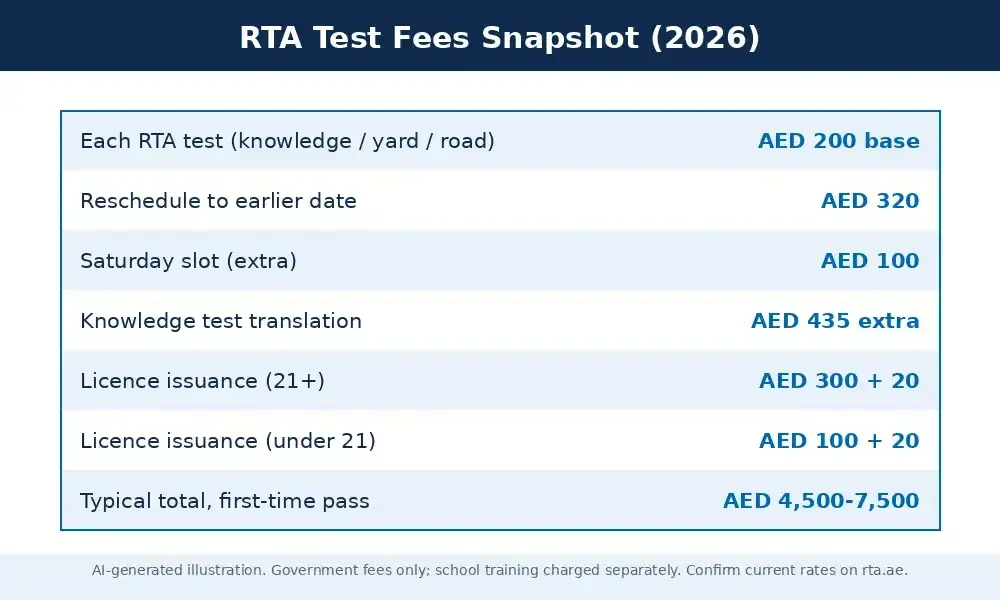
- Pass the knowledge test. Score 23 out of 35. You can request remote interpretation in your language for an extra fee, which you can request when you open your file.
- Take driving lessons. Practical lessons cover steering, braking, lane changes, roundabouts and parking. New drivers train for around 40 hours.
- Pass the yard (parking) test. Clear the five Smart Yard manoeuvres.
- Complete highway training. This includes at least 4 lessons (about 2 hours) of freeway driving at 100 km/h or more, so you are ready for fast roads.
- Pass the road test. It’s the final on-road exam with an RTA examiner.
- Get your licence. Once you pass, RTA issues your licence — often the same day or within a few days.
Source: AI Generated/Human Edited
|
Tip! - If no official RTA test (theory, yard or road) is taken within 6 months of your last appointment, your traffic file can be suspended. Keep your momentum once you start. |

RTA Road Test Checklist: What Do Examiners Check?
Source: AI Generated/Human Edited
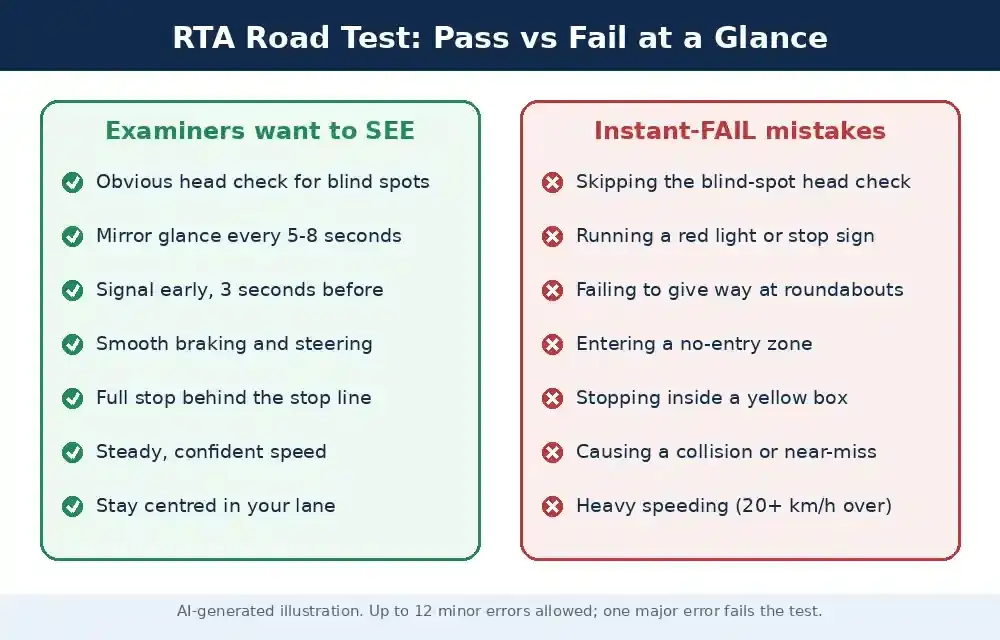
Examiners start judging you before you even move. Use this checklist as your test-day routine. Each block below is a moment where people commonly lose marks.
1. Before you start the engine (cockpit drill)
- Close all doors properly.
- Adjust your seat so you reach the pedals comfortably.
- Adjust all mirrors for full visibility.
- Fasten your seatbelt before starting the car.
- Check that warning lights are clear. Also, confirm that indicators, lights, wipers, and horn work.
Do this calmly but without dragging. Taking too long shows hesitation.
2. Mirrors and blind spots
- Glance at your mirrors every 5–8 seconds.
- Check mirrors before braking, signalling, or turning.
- Do a clear, visible head turn (shoulder check) for blind spots before moving off, merging, or changing lanes.
3. Signals and lane changes
- Signal early — about 3 seconds before a turn or lane change.
- Take a real, clear gap. Never squeeze into a tight space or swerve suddenly.
- Stay centred in your lane and avoid drifting.
- Return to the right lane after overtaking.
4. Speed, gears and control
- Keep a steady, safe speed that matches the road — not too fast, not too slow.
- Brake and accelerate smoothly. Jerky pedals signal poor control.
- Use the correct gear, and never put your car in neutral while moving (manual).
- Keep a 3–4 second gap from the car in front.
5. Roundabouts, turns and stopping
- Give way correctly at roundabouts — failing to yield is a common instant fail.
- Approach turns at a steady speed. Avoid braking hard or pressing the clutch too early.
- Stop fully behind the stop line; no rolling stops.
- Avoid unnecessary stops that block traffic flow.

6. Parking and reversing
-
Enter from the correct lane and never stop on lay-by lines.
- Centre the car in the bay without hitting the curb.
- Complete parking in four moves or fewer.
- Signal and check blind spots before reversing or leaving the bay. Exit to the right lane.
RTA Driving Test Mistakes: Major vs Minor
Understanding the scoring removes a lot of fear. There are two types of mistakes, and they are treated very differently.
| Type | What it Means | Effect on Your Result |
|---|---|---|
| Major (serious) mistake | A dangerous error or a clear safety breach | Even one usually fails you on the spot |
| Minor mistake | A small slip that does not endanger anyone | Allowed up to about 12; 13 or more fails you |
Note: The exact minor-mistake limit can vary slightly with the examiner’s overall judgement, but the widely used guide is up to 12 minor errors before a fail.
Major Mistakes That Fail You Instantly
- Causing a collision or a near-miss or forcing the examiner to take control
- Running a red light or not stopping fully at a stop sign
- Failing to give way at a roundabout
- Entering a no-entry zone
- Stopping inside a yellow box junction
- Excessive speeding (for example, 20 km/h or more over the limit)
- Not checking mirrors or blind spots before changing lanes
Minor Mistakes That Add Up
- Inconsistent mirror checks
- Signalling too late or too early
- Rolling slowly instead of a full stop
- Slight hesitation when it is safe to go
- Drifting a little within your lane
RTA Driving Test Tips to Pass on the First Attempt
These Dubai driving test tips combine official guidance with what experienced instructors repeat most often:
- Read the official RTA handbook. The document is free in English, Arabic, and Urdu. It covers signs, rules, and newer road elements like tram signals.
- Practice with the official mock tests. Use the RTA app’s practice tests and the Driving Test Routes app to learn common routes.
- Book a morning or quiet-day slot. Less traffic means calmer conditions and fewer surprises.
- Make your checks visible. Move your head for mirrors and blind spots so the examiner can clearly see you are aware.
- Drive smoothly. Gentle braking and steady acceleration show control. Avoid hard, sudden braking.
- Greet the examiner and listen. Start with a calm greeting, listen carefully to each instruction, and ask if you are unsure.
- Do not over-correct. If you make a small slip, stay calm and keep driving safely. One minor mistake is not a failure.
- Take extra practice hours if unsure. A couple of focused lessons on your weak area (often parking or roundabouts) pay off.
What is New for 2026? (RTA Updates Worth Knowing)
Staying updated is part of being a safe driver. The RTA keeps updating how it trains and tests. Two recent changes stand out:
- Smart vehicle technology added to the curriculum. In 2026, the RTA updated its driving-licence training to include modern Advanced Driver Assistance Systems (ADAS), such as forward collision warning, blind-spot monitoring, and lane-keeping assist. The RTA says the goal is to improve road safety and prepare drivers for today’s cars, and that the new content was added with driving institutes across Dubai.
- Automated “Smart Yard” parking test. The yard (parking) test in Dubai now uses an automated Smart Yard system that reduces human error and improves the accuracy of results. The five components — parallel, roadside (60-degree), garage, slope, and sudden braking — stay the same, but scoring is more consistent.
Alongside this, UAE-wide enforcement has tightened, with AI traffic cameras that can detect several violations at once (speeding, tailgating, lane discipline, seatbelt, and phone use).
Frequently Asked Questions (FAQs)
How many mistakes are allowed in the RTA road test?
You can make up to about 12 minor mistakes. Thirteen or more fail you. Any single major (dangerous) mistake fails you instantly, regardless of your minor count.
How long is the RTA road test?
The on-road test takes roughly 20 minutes. An examiner rides with you and gives directions while scoring your driving.
What car will I drive in the road test?
You take the test in a vehicle assigned by the RTA — usually a standard automatic sedan, like the cars used at driving schools.
How many questions are on the RTA theory test and what is the pass mark?
Out of 35 questions, you must answer 23 correctly (65%) to pass. You usually have about 30 minutes.
How many times can I retake the road test?
There is no fixed limit. After each failed road test, you must complete 4 hours of practical training before you can rebook.
How long is the RTA test result valid?
The road test certificate is valid for 30 days from the issue date.
Can I reschedule my RTA test?
Yes. Postponing is free if you do it at least 24 hours before your booked date. Moving the test to an earlier date costs around AED 320 (plus a small knowledge and innovation fee).
Does anyone pass on the first try in Dubai?
Yes, many people do. Success depends mostly on preparation, practice, and staying calm.
What are the most common reasons people fail?
Skipping blind-spot head checks, not giving way at roundabouts, poor lane discipline, rolling stops, and nerves.
Is there an app for RTA test routes?
Yes. The RTA Driving Test Routes app helps learners practise common test routes. The RTA app also offers mock theory tests.
Know More About Car Insurance
Car Insurance DubaiCar Insurance SharjahCar Insurance Abu DhabiCheck Vehicle Insurance Status OnlineComprehensive Car InsuranceThird Party Car Insurance in Dubai

More From Car Insurance
- Recent Articles
- Popular Articles
 Last Updated : 07 Aug 2026 Agreed Value vs Market Value Insurance for Classic Cars in UAE (2026)Understand the difference between agreed value and market value insurance for classic cars in the UAE. Compare coverage, claim settlements, premiums, and valuation methods.
 Last Updated : 05 Aug 2026Car Insurance with Tabby in the UAE | Interest-Free PaymentsBuy car insurance with Tabby in the UAE and split your premium into 4 interest-free instalments with no processing fees and no minimum premium requirement.
 Last Updated : 07 Aug 2026 Import JDM & Right-Hand-Drive Classic Cars to UAEPlanning to import a JDM or right-hand-drive classic car to the UAE? Explore 2026 import regulations, RTA inspections, import costs, & insurance requirements..
 Last Updated : 03 Aug 2026Driving to Oman or Saudi Arabia: Which Car Insurance and Border Documents Do You Really Need?Planning to drive from the UAE to Oman or Saudi Arabia? know which car insurance, border permits, and essential documents you need for a smooth cross-border journey.
 Last Updated : 28 Jul 2026Orphaned Chinese Car Brands in the UAE: Insurance and Spare Parts AvailabilityUnderstand what an orphaned car brand is, why some Chinese car brands have exited the UAE market, and how it can affect insurance, repairs, spare parts, and long-term ownership.
 Last Updated : 28 Jul 2026Smart Summon & Autonomous Parking Accidents in the UAE: Liability ExplainedFind out how liability is determined when a Smart Summon or autonomous parking feature causes an accident in the UAE, and what it means for your car insurance claim.
 Last Updated : 04 Jun 2026How to Check Car Insurance Status Online in UAE - 2026Check Car Insurance Status Online - Checking your vehicle insurance status online in UAE with these methods RTA Website , EVG , MoI ,Policybazaar.ae & more.
- Last Updated : 31 Jul 202610 Best Car Insurance Companies in Dubai, UAE - 2026Checkout the list of top 10 best car insurance companies in Dubai, UAE with their products & service benefits that they offer so you can choose best as per your needs.
 Last Updated : 24 Mar 2026How to Transfer Vehicle Ownership in UAE - Process, Documents, FeesTransfer Car Ownership in UAE - Checkout Step by step guidance to transfer your car registration & ownership when you are selling or buy used cars in UAE
 Last Updated : 21 Jul 2026Abu Dhabi Traffic Fines 2026 - Complete List, Payment & MoreGet the updated list of Abu Dhabi traffic fines for 2026, including speeding fines, number plate violations, reckless driving penalties, and more. how to check and pay Abu Dhabi Police traffic fines online.
.jpg) Last Updated : 15 Jun 2026Abu Dhabi Parking SMS - Format, Codes, Types, Charges, How to PayGet the Comprehensive Guidance for SMS Parking in Abu Dhabi. Also know how to Pay for MAWAQIF Parking, Parking types and charges, Code List, Benefits, Extensions, & more about Abu Dhabi Parking SMS.
Last Updated : 15 Jun 2026Abu Dhabi Parking SMS - Format, Codes, Types, Charges, How to PayGet the Comprehensive Guidance for SMS Parking in Abu Dhabi. Also know how to Pay for MAWAQIF Parking, Parking types and charges, Code List, Benefits, Extensions, & more about Abu Dhabi Parking SMS. Last Updated : 01 May 2026How to Check Black Points on License in Dubai | Black Points DubaiBlack Points Dubai - Know black points system in Dubai & Also know how to check & reduce black points in Dubai, penalty, rule & regulation & more.
Disclaimer▼




 Google Reviews