Best SIP Plan for 20 Years
Investment in SIP plan for 20 years spans multiple market cycles, booms, corrections, crashes, and recoveries. Short-term returns may certainly fluctuate. But over long periods, disciplined investing and compounding tend to smooth out volatility and reward patience. That’s why understanding the ...read more

4.6/5
35,368
 Reviews
Insurance Partners
Trusted Customers
Policies Sold

Get AED 1 Million Returns*


What Makes an SIP Plan for 20 Years Different from Short-Term SIPs?
The best SIP for 20 years is shaped more by behaviour and consistency than by short-term performance. In shorter SIPs, the starting market level heavily influences outcomes. Over 20 years, this impact fades.
What matters instead is —
- Staying invested across multiple market cycles
- Choosing funds that can survive different economic environments
- Avoiding frequent changes driven by fear or excitement
Over two decades, markets will rise, fall, stagnate, and recover — often more than once. A long-term SIP does not try to predict these phases. It simply keeps investing through all of them.
Three Defining Traits of an SIP Plan for 20 Years
- Equity plays a central role: Inflation-adjusted wealth creation over long periods has historically come from equity and equity-oriented funds.
- Volatility becomes an advantage: Market declines allow SIPs to accumulate more units at lower prices automatically.
- Discipline matters more than strategy tweaks: Frequent fund switches or stopping SIPs often harm long-term outcomes more than market volatility itself.
Best Investment Plans in UAE
Some of the best Investment quotes in UAE & Dubai are:




Why Choose SIP for 20 Years?
SIPs allow you to regularly invest a fixed amount of money in mutual funds. This lets you take advantage of market fluctuations and create wealth over the long term. When you invest for 20 years, you unlock the potential for long-term growth.
The key benefits of choosing an SIP for this time frame are —
- Compounding Growth: Reinvesting returns helps grow your corpus exponentially
- Rupee Cost Averaging: SIPs help mitigate the impact of short-term market volatility, reducing the risks associated with timing the market
- Discipline in Investing: Regular, automatic investments promote financial discipline
Best SIP Plans for 20 Years 2026: Equity, Debt & Hybrid
A 20-year SIP horizon gives your investments enough time to benefit from compounding, market cycles, and disciplined investing. However, the outcome largely depends on the mutual fund category you choose: equity, debt, or hybrid.
Let’s understand how each category works with real-life SIP planning scenarios.
If you are an NRI investing investing in India, here’s a curated list of the best SIPs to invest for 20 years that may bring strong returns and align well with long-term investment objectives —
|
Best SIP for 20 Years |
AUM |
Expense Ratio |
Annualised Return (3 Yrs) |
|---|---|---|---|
|
LIC MF Infrastructure Fund-Direct Plan-Growth |
946.24 |
1.00% |
28.82% |
|
Kotak Bluechip Fund-Direct Plan-Growth |
10,864.16 |
1.73% |
14.49% |
|
HDFC Flexi Cap Fund-Direct Plan-Growth |
97,451.56 |
0.67% |
22.87% |
|
Invesco India Large & Mid Cap Fund - Growth |
8,958.63 |
1.75% |
22.94% |
|
Canara Robeco Bluechip Equity Fund-Direct Plan-Growth |
17,093.93 |
0.50% |
15.49% |
|
Parag Parikh Flexi Cap Fund-Direct Plan-Growth |
133,969.81 |
0.63% |
20.55% |
|
Bandhan Core Equity Fund-Direct Plan-Growth |
13,968.37 |
0.53% |
23.73% |
|
Nippon India Large Cap Fund-Direct Plan-Growth |
50,107 |
0.68% |
18.57% |
Overview of the Best SIPs to Invest for 20 Years
Here’s a detailed overview of some of the highest return SIPs for 20 years —
1. LIC MF Infrastructure Fund-Direct Plan-Growth
Type: Sectoral Infrastructure Fund
Investment Breakdown*: 94.61% in domestic equities, divided as follows:
- 9.22% in Large Cap stocks
- 19.93% in Mid Cap stocks
- 34.97% in Small Cap stocks
Suitable For: Those who can make selective investments based on specific sectors (such as infrastructure) and are willing to accept higher risk and potential volatility in exchange for higher returns
Exit Load: A 1% exit load is charged on redemptions within 90 days for units exceeding 12% of the initial investment
Returns
- Since Launch: 17.26% average annual return
- Doubling Time: The fund has doubled its investment every 2 years
Top Holdings
- Garware Hi-Tech Films Ltd.
- Shakti Pumps (India) Ltd.
- REC Ltd.
2. Kotak Bluechip Fund-Direct Plan-Growth
Type: Large Cap Fund
Investment Breakdown: 96.53% in domestic equities, categorised as follows —
- 67.65% in Large Cap stocks
- 10.88% in Mid Cap stocks
- 3.39% in Small Cap stocks
Suitable For: Investors looking to invest for a long duration for high returns
Note: As an investor, you should be prepared for moderate risk.
Expense Ratio: This varies based on the plan chosen, but performance details are based on the Direct Plan
Returns
- Since Launch: 15.43% average annual return
Top Holdings
- Reliance Industries Ltd.
- HDFC Bank Ltd.
- Infosys Ltd.
3. HDFC Flexi Cap Fund-Direct Plan-Growth
Type: Flexi Cap Fund
Investment Breakdown: 87.39% in domestic equities:
- 56.7% in Large Cap stocks
- 4.78% in Mid Cap stocks
- 3.9% in Small Cap stocks
Note: The fund also has 0.76% of its investment in debt (Government securities)
Suitable For: This is one of the best SIP plans for 20 years for investors who are looking for high returns but are also prepared for moderate risk
Exit Load: 1% for redemptions within 1 year
Returns
- Since Launch: 17.34% average annual return
- Doubling Time: The fund has doubled the money invested in it every 3 years
Top Holdings
- HDFC Bank Ltd.
- ICICI Bank Ltd.
- Axis Bank Ltd.
4. Invesco India Large & Mid Cap Fund-Direct Plan-Growth
Type: Large & Mid Cap Fund
Investment Breakdown: 98.54% in domestic equities:
- 15.75% in Large Cap stocks
- 24.6% in Mid Cap stocks
- 19.58% in Small Cap stocks
Suitable For: Investors who have an eye on high returns but are also prepared for some moderate volatility
Exit Load: 1% exit load for redemptions above 10% of the investment within 1 year
Returns
- Since Launch: 19.14% average annual return
- Doubling Time: The fund has doubled its money every 2 years
Top Holdings
- Trent Ltd.
- Interglobe Aviation Ltd.
- ICICI Bank Ltd.
5. Canara Robeco Bluechip Equity Fund-Direct Plan-Growth
Type: Bluechip Equity Fund
Investment Breakdown: 97.22% in domestic equities —
- 67.38% in Large Cap stocks
- 10.69% in Mid Cap stocks
- 0.99% in Small Cap stocks
Suitable For: Those seeking stable returns and lower risk, particularly those focused on large-cap stocks
Exit Load: 1% exit load for redemptions within 1 year — applicable to SIPs as well
Returns
- Since Launch: 15.66% average annual return
- Doubling Time: The fund has doubled the money invested in it every 5 years
Top Holdings
- HDFC Bank Ltd.
- ICICI Bank Ltd.
- Infosys Ltd.
6. Parag Parikh Flexi Cap Fund-Direct Plan-Growth
Type: Flexi-Cap Fund
Investment Breakdown: 66.85% in Domestic Equities in the following categories —
- 49.29% in Large Cap stocks
- 2.47% in Mid Cap stocks
- 5% in Small Cap stocks
6.46% in Debt Investments, including:
- 1.23% in Government Securities
- 5.23% in Low-Risk Securities
Suitable For: Investors aiming for long-term growth with the potential for high returns but also prepared for moderate losses in volatile markets
Exit Load
- 2% exit load if redeemed within 365 days for amounts above 10% of the investment
- 1% exit load if redeemed after 365 days but on or before 730 days
Recent Performance
- Since Launch: 20.57% average annual return
- Doubling Time: Every 4 years
Top Holdings
- HDFC Bank Ltd.
- Power Grid Corporation of India Ltd.
- Bajaj Holdings & Investment Ltd.
7. Bandhan Core Equity Fund-Direct-Growth
Type: Large & Mid-Cap Equity Fund
Investment Breakdown: 92.43% in Domestic Equities, distributed as:
- 32.3% in Large Cap stocks
- 23.43% in Mid Cap stocks
- 12.54% in Small Cap stocks
Suitable For: Investors seeking high returns but prepared for volatility
Exit Load: 1% exit load if redeemed within 1 year for units exceeding 10% of the investment
Recent Performance
- Since Launch: 16.97% average annual return
- Doubling Time: Every 3 years
Top 3 Holdings
- ICICI Bank Ltd.
- HDFC Bank Ltd.
- Infosys Ltd.
8. Nippon India Large Cap Fund-Direct Plan-Growth
Type: Large-Cap Fund
Investment Breakdown: 98.76% in Domestic Equities, with:
- 64.6% in Large Cap stocks
- 11.39% in Mid Cap stocks
- 3.34% in Small Cap stocks
Suitable For: Investors seeking relatively safer, long-term capital appreciation through large-cap stocks
Exit Load: 1% exit load if redeemed within 7 days for units exceeding 10% of the investment
Recent Performance
- Since Launch: 16.90% average annual return
- Doubling Time: Every 4 years
Top Holdings
- HDFC Bank Ltd.
- ICICI Bank Ltd.
- Reliance Industries Ltd.

What Can a ₹10K SIP for 20 Years Grow Into?
A ₹10,000 monthly SIP (≈ AED 440) invested consistently for 20 years can create a powerful long-term corpus. The final value depends mainly on asset class returns and market cycles.
Common Assumptions
- Monthly SIP: ₹10,000 (≈ AED 440)
- Investment period: 20 years
- Total investment:
₹10,000 × 12 × 20 = ₹24,00,000 (≈ AED 105,000)
This wealth is not created by one exceptional year. It is built through —
- Regular investing across market ups and downs
- Compounding over a long period
- Staying invested during both market rallies and corrections.
Categories for Best SIP for 20 Years Investment Horizon
When people search for the best SIP plans for 20 years, they often expect a list of funds. In reality, choosing the right categories is more important than choosing individual schemes.
1. Flexi-Cap Equity Funds
Flexi-cap funds can invest across large, mid, and small-cap companies. They work well for long-term SIPs because —
- Built-in diversification across market sizes
- Fund managers can adjust allocations as market conditions change
- Suitable as a core holding for investors who prefer simplicity
These funds are often a strong foundation for a 20-year SIP portfolio.
2. Large-Cap Equity Funds
Large-cap funds invest in established companies with stable business models. Their role includes —
- Lower volatility compared to mid and small caps
- Easier to stay invested during market corrections
- Provide stability to balance more aggressive funds
For conservative or moderate investors, large-cap funds often anchor the portfolio.
|
Did You Know? |
|---|
3. Aggressive Hybrid Funds
Aggressive hybrid funds invest mostly in equity, with a meaningful allocation to debt. They suit investors who —
- Participate in equity growth with reduced volatility
- Built-in rebalancing between equity and debt
- Help investors stay invested during difficult market phases
These funds are useful for investors who want growth but prefer some downside cushioning.
4. Multi-Cap Equity Funds
Multi-cap funds maintain exposure to large, mid, and small caps in fixed proportions. You can expect —
- Participation across the full equity spectrum
- Higher volatility than large-cap funds
- Higher growth potential over long periods
They work best for investors with higher risk tolerance and a genuinely long horizon.
5. ELSS (Tax-Saving Equity Funds)
ELSS funds invest in equities and offer tax benefits under Section 80C, with a 3-year lock-in. In an SIP plan for 20 years, it’s —
- Useful for combining tax planning with equity investing
- Lock-in discourages impulsive exits
- Should complement, not replace, core equity funds
Categories Best Avoided for an SIP Plan for 20 Years
A long horizon does not justify unnecessary complexity. Sector-specific, thematic, or highly concentrated funds are better treated as satellite holdings, if used at all. They —
- Increase volatility
- Depend heavily on timing
- Add complexity without essential benefits
You can build long-term wealth more reliably by using broad, diversified funds.
How to Structure the Best SIP for 20 Years Portfolio?
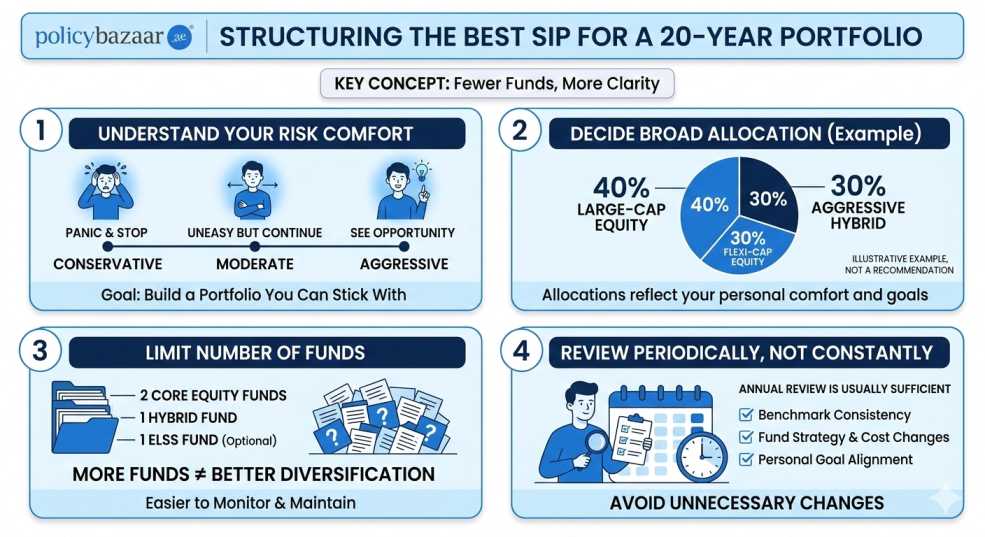
Infographic Source: Gemini
A long-term SIP portfolio does not need many funds. It needs clarity.
Step 1: Understand Your Risk Comfort
Ask yourself how you would react to a 25–30% market fall:
- Panic and stop investing → conservative
- Feel uneasy but continue → moderate
- View it as an opportunity → aggressive
The goal is not to chase returns, but to build a portfolio you can stick with.
Step 2: Decide Broad Allocation
For a moderate investor —
- 40% large-cap equity funds
- 30% flexi-cap equity funds
- 30% aggressive hybrid funds
This is an example, not a recommendation. Allocations should reflect your comfort and goals.
Step 3: Limit the Number of Funds
More funds do not equal better diversification. For most long-term SIP investors, here’s what can work —
- 2 core equity funds
- 1 hybrid fund
- 1 ELSS fund (if tax saving is needed)
This structure is easier to monitor and maintain.
Step 4: Review Periodically, Not Constantly
An annual review is usually sufficient to check —
- Consistency with benchmarks
- Changes in fund strategy or cost
- Alignment with personal goals
Frequent reviews often lead to unnecessary changes.

SIP Calculator
How to Choose the Best SIP Plan for 20 Years?
The best SIP plan for 20 years is the one you can continue quietly through every market phase. Here’s what you can do —
- Start with the right fund category
- Look for consistency, not one-year outperformance
- Prefer simple, low-cost funds
- Avoid unnecessary overlap
- Align SIPs with specific goals like retirement or education
Disclaimer: The information provided here is for educational purposes only and should not be considered financial or investment advice. Investors are advised to consult a qualified financial advisor before making investment decisions. The author and publisher are not responsible for any losses arising from investment decisions based on this content.
FAQs for Best SIP for 20 Years
Is it good to do SIP for 20 years?
Yes, SIPs are a great way to build wealth over 20 years. The long duration allows you to benefit from compounding, mitigate market volatility through cost averaging, and build disciplined investing.
Can SIPs be modified during the tenure?
Yes, SIPs are mostly flexible. You can increase, decrease, or stop your SIP contributions anytime by cancelling the existing mandate and providing a revised one.
Which SIP is best for 20 years?
Some of the best SIP plans for 20 years include —
- Axis Bluechip Fund
- Parag Parikh Flexi Cap Fund
- ICICI Prudential Bluechip Fund
- Kotak Standard Multicap Fund
- Nippon India Multi Cap Fund
What is the average SIP return for 20 years?
The average SIP return over 20 years depends on the fund category and market cycles. Historically, large-cap equity funds have delivered around 12–18%, mid-cap funds about 14–17%, while long-term debt funds typically return 6–9%.
Is 20 years a good time frame for SIPs?
Yes, 20 years is an excellent time frame for SIPs, especially in equity and aggressive hybrid funds. It allows compounding to work fully across multiple market cycles, helping investors ride out volatility and build long-term wealth for goals like retirement or education.
How much should I invest in a 20-year SIP?
The right SIP amount depends on your goal value, time horizon, and monthly cash flow. Estimate your future requirement, work backwards using conservative return assumptions, and choose an SIP amount you can sustain comfortably and increase gradually as income grows.
Which fund type is safest for 20 years?
Over 20 years, ‘safety’ means beating inflation, not avoiding volatility. Large-cap equity funds and aggressive hybrid funds offer a balanced mix of stability and growth, while pure debt funds are better suited for shorter-term or income-focused goals.
Should I stop SIPs during a market crash?
No. Continuing SIPs during market crashes helps you buy more units at lower prices, improving long-term returns. Stopping SIPs breaks discipline and often leads to poor timing decisions that hurt wealth creation.
Can I modify my SIP allocation during the 20-year period?
Yes, SIPs can be modified when your income, goals, or risk tolerance change, or as you near your goal timeline. However, frequent changes based on short-term market movements usually reduce the effectiveness of long-term investing.
How are SIP investment returns calculated?
SIP returns are calculated using the XIRR (Extended Internal Rate of Return) method. This accounts for multiple investments made at different times and reflects the true annualised return of your SIP.
Is SIP better than lump sum for 20 years?
Yes. SIPs reduce timing risk through rupee cost averaging and encourage long-term discipline. Over 20 years, SIPs help investors stay invested across market cycles, which is critical for compounding to work effectively.
Can SIP make me a crore in 20 years?
A disciplined SIP of around ₹10,000 per month (or equivalent) in equity funds, combined with step-ups and long-term returns of 11–12%, can potentially grow into a ₹1 crore corpus over 20 years.
Should I choose one SIP or multiple SIPs for 20 years?
A combination works best. Many long-term investors use 2–3 SIPs across large-cap, flexi-cap, and hybrid funds to balance growth and stability while avoiding over-diversification.
How often should I review my SIP over 20 years?
A review once a year is sufficient. The focus should be on fund consistency and goal alignment rather than short-term performance or market noise.
Does inflation affect SIP returns over 20 years?
Inflation reduces real purchasing power. Equity-oriented SIPs are preferred for long horizons. This is because, unlike fixed-income options, they have historically beaten inflation over long periods.
Can I pause or stop SIPs during financial stress?
SIPs are flexible and can be paused or stopped without penalties. However, stopping frequently or during market corrections may reduce long-term returns.


More From Investment
- Recent Articles
- Popular Articles
 Last Updated : 15 Jan 2026UAE Visa Updates 2026: New Golden Visa Rules, Visit Visas & Who BenefitsUAE visa updates 2026 explained. New Golden Visa categories, visit visas, AI renewals, sponsorship rules & benefits for Indians and professionals.
- Last Updated : 06 Nov 2025Sports and Culture UAE Golden Visa: Residency Through Sports Investment & TalentDiscover how the UAE Sports and Culture Golden Visa offers 10-year residency to elite athletes, coaches, and investors. Learn eligibility, documents, and how sports connect cultures in Dubai and across the Emirates.
- Last Updated : 08 Oct 2025Top Benefits of Long-Term Residency in UAE for FamiliesDiscover the top benefits of UAE long-term residency for families through the Golden Visa program. Learn how it offers 5–10 year residency, world-class education, advanced healthcare, tax-free income, and greater family security.
 Last Updated : 07 Oct 2025UAE Golden Visa: Real Estate or Yacht Ownership – Which Investment Path Is Right for You?Compare real estate and yacht ownership options for the UAE Golden Visa. Learn which investment path—property or luxury yacht—offers better returns, tax benefits, and long-term residency advantages for global investors and HNIs.
 Last Updated : 04 Nov 2025Why More HNIs Are Choosing UAE Over Europe for ResidencyDiscover why high-net-worth individuals prefer UAE residency over Europe. Learn how 10-year Golden Visa, real estate opportunities, and luxury living make Dubai the best residency option for HNIs.
- Last Updated : 07 Oct 2025From Golf Courses to Yachts: Why UAE HNIs Choose Golden Visa Investment PlansDiscover why high-net-worth individuals prefer UAE Golden Visa investment plans. Explore luxury lifestyle options from golf course properties to yacht investments, and learn how HNIs benefit from long-term residency and exclusive Golden Visa privileges.
 Last Updated : 14 Jan 202610 Best Mutual Funds in UAE to Invest to Right NowDiscover the top 10 best mutual funds in UAE and Dubai for 2026. Compare performance, features, and find the best mutual fund investment in UAE for your goals.
 Last Updated : 14 Jan 202615 Best Short Monthly Investment Plan in UAE with High ReturnsRecurring Deposits (RDs) are among the best monthly investment plans in UAE for those who prefer to save consistently over time.
 Last Updated : 18 Mar 2026Top 10 Best Trading Platforms in UAE, Dubai (2026)Explore the 10 best online trading platforms in the UAE, including eToro, Plus500, and Interactive Brokers. Learn about their features, benefits, and safety measures for both beginners and seasoned traders.
 Last Updated : 10 Dec 2025 How to Invest AED 10,000 in UAE to Multiply Your Money?Explore the best investment plans in UAE's thriving market to invest your AED 10000 to help you turn your savings into a profitable venture.
 Last Updated : 30 Mar 2026National Bonds in UAE Discover the benefits of National Bonds in UAE. Learn how to invest in National Bonds in Dubai, their features, and why they are a secure investment option.
 Last Updated : 06 Jan 2026Top 5 SIP Plans for Smart Investing Discover the top 5 SIP plans for smart investing in the UAE. Explore the best mutual funds for SIP investments and make informed financial decisions.