Compulsory Excess in Car Insurance
Compulsory Excess in car insurance is the amount you must pay from your own pocket whenever you make a claim. It’s a normal part of most car insurance policies in the UAE. This amount is fixed and mentioned in your policy. Paying the excess means you’re covering a part of the repair cost, while your insurer pays the rest. It also helps keep insurance premiums lower for everyone.read more




4.7/5
43,725
 Reviews
Central Bank UAE Registration No.: - 123
Insurance Partners
Trusted Customers
Policies Sold
.webp)


Best Car Insurance in UAE
Some of the best and the cheapest car insurance quotes in Dubai are:
When Do You Pay Insurance Excess in the UAE?
In the UAE, insurance excess is usually paid whenever you file a claim under your car insurance policy. This applies to most damage-related claims listed under the “Own Damage” section in policies issued by insurers. You may need to pay the compulsory excess in car insurance even if the accident was not your fault — especially in cases where the other party is unknown or cannot be identified.
For example, in hit-and-run situations or when your parked car is damaged without any third-party involvement, the excess is generally deducted from the claim amount you receive.
Here’s a quick overview —
| Scenario | Is Excess Payable? | Notes |
|---|---|---|
| You caused the accident | Yes | Standard compulsory excess applies |
| Car damaged by flood or rain | Yes | Natural events covered (usually as add-on), but excess still applies |
| Car stolen or total loss | No | GIG, Sukoon and others waive excess in total loss and theft cases |
| Hit-and-run, no third party known | Yes | Treated as “own damage”; excess applies |
| Vandalism or a scratch while parked | Yes | No third party involved; excess is payable |
Disclaimer: These examples are based on UAE insurer documents reviewed. Actual excess application may differ by policy and claim circumstances. Always refer to your insurer for case-specific guidance.

How Much Is the Excess in UAE Motor Insurance?
The amount of insurance excess you pay in the UAE depends on your vehicle type, the insurer you choose and sometimes the driver's profile. Most policies clearly state a compulsory excess in car insurance, which usually starts from AED 200. Sports and modified cars may come with even higher excess amounts—or, in some cases, limited coverage.
| Vehicle Type | Watania | GIG | Methaq | Sukoon | Alliance |
|---|---|---|---|---|---|
| Sedan | AED 350 | AED 500 | AED 500 | AED 500 | AED 500 |
| SUV | AED 500–750 | AED 750 | AED 750 | AED 750 | AED 750 |
| Luxury / Sports Cars | NA | AED 1,500 | Limited | AED 1,500+ | AED 1,500 |
Disclaimer: The above excess values are taken from real UAE insurer policy documents for reference only. Actual amounts may vary based on the insurer’s underwriting criteria, vehicle specifications and policy terms.
Are There Any Additional Charges Besides Compulsory Excess?
Yes, in addition to the basic compulsory excess, some UAE insurers apply other deductibles in special cases, such as for specific types of claims or vehicles. These are referred to as “ancillary deductibles” or “special excess”. The exact conditions for any additional excess charges vary by insurer. Always refer to your policy’s Schedule of Benefits or contact your provider directly for clarification.
What If You're Not At Fault? Do You Still Pay Excess?
In many cases, you may still have to pay the compulsory excess even if the accident wasn't your fault. Most insurers refer to the excess as being “payable per claim”.
| Scenario | Do You Pay Excess? | Notes |
|---|---|---|
| Hit-and-run, no third party found | Yes | Treated as own damage; excess applies |
| Car scratched while parked, no witness | Yes | No one to claim against; excess applies |
| Theft or fire | No | Most insurers waive excess for these scenarios |

How to Reduce the Impact of Paying Excess in the UAE?
While you can't avoid compulsory excess in car insurance, you can take a few smart steps to reduce its financial impact, especially when dealing with unexpected claims.
- Understand Your Policy Clearly: Before buying or renewing your policy, read the Schedule of Benefits. It usually lists the exact excess amount for your vehicle type. Some policies may offer lower excess at a slightly higher premium, which could save money in the long run if you drive frequently or in crowded areas.
- Choose the Right Insurer: Different UAE insurers apply different excess structures. For instance, some apply basic excess from AED 200, while others may offer variations based on vehicle specs or claim history. Always compare policies, not just premiums.
- Avoid Small Claims: If repair costs are only slightly above your excess (say AED 1,000 with an AED 500 deductible), consider paying out-of-pocket. Filing frequent claims for minor repairs can increase your premium at renewal, and doesn’t offer much financial benefit after the excess is applied.
- Ask About Waivers for Total Loss or Theft: Some car insurers waive the excess for total loss and theft. It's worth checking this when choosing your policy, especially if your car is new or high value.
Did you know? Policybazaar.ae, under its PB Advantage Program, offers an excess waiver of up to AED 1,000*. Go through the terms and conditions of this program for more details and get your car insurance in UAE only from Policybazaar.ae! Buy the best plan today!
Also Read - What is Car Insurance Excess
Frequently Asked Questions (FAQs)
Do insurers charge excess if the car is being driven outside the UAE?
Yes, if your policy covers GCC countries, especially Oman and you're driving outside the UAE, any valid claim will still be subject to the same basic excess unless stated otherwise. Usually, the excess is double the standard amount charged in the UAE.
Is excess applied separately for each accident or once per policy term?
Excess is applied per accident or per claim, not per year. This means each time you file a new claim, the compulsory excess will be deducted from the settlement amount.
Does excess apply to personal accident benefits or medical expenses?
No, personal accident cover or medical benefits (e.g. driver/passenger injury compensation) are generally paid out without applying excess. The deductible is mostly tied to vehicle repairs under "Own Damage".
If the insured fails to report the accident within a time limit, does the excess change?
While excess may not change, failing to report the accident promptly (generally within 24–48 hours) may lead to claim rejection altogether, which overrides any discussion of excess.
Is excess charged when the vehicle is declared a total loss?
No. Most UAE car insurers waive the excess in case of total loss or theft. You receive the insured declared value (IDV) without any deductible being subtracted.
Is excess mentioned for specific components like glass, mirrors or tyres?
Yes. Some policies include clauses that exclude excess or apply a different fixed amount for claims involving windscreen, mirrors, tyres or lights — if damage is not part of a wider collision.
Can excess be negotiated or removed during policy purchase?
You cannot remove compulsory excess. It is a mandatory component in all comprehensive motor policies.

More From Car Insurance
- Recent Articles
- Popular Articles
 Last Updated : 17 Aug 2026Waterless Car Wash Dubai 2026 | Cost & How It WorksExplore waterless car wash in Dubai, including 2026 rules, how to work, costs, benefits and eco-friendly cleaning methods. Know how to clean your car while saving water.
 Last Updated : 17 Aug 2026Mobile Car Wash in Dubai: Best Home Car Wash Services & PricesExplore mobile car wash services in Dubai, including home car wash options, prices, benefits, and how to choose the right service for your car.
 Last Updated : 17 Aug 2026Elite Car Wash Dubai : Services, Prices and LocationsExplore Elite Car Wash Dubai services, prices, and locations. Find available car wash options, costs, and key details to choose the right service for your car.
 Last Updated : 17 Aug 2026Self-Service Car Wash in Dubai - Types, Prices, Locations, and RulesExplore self service car wash options in Dubai, including types, prices, locations, rules, and how to wash your car yourself at affordable rates.
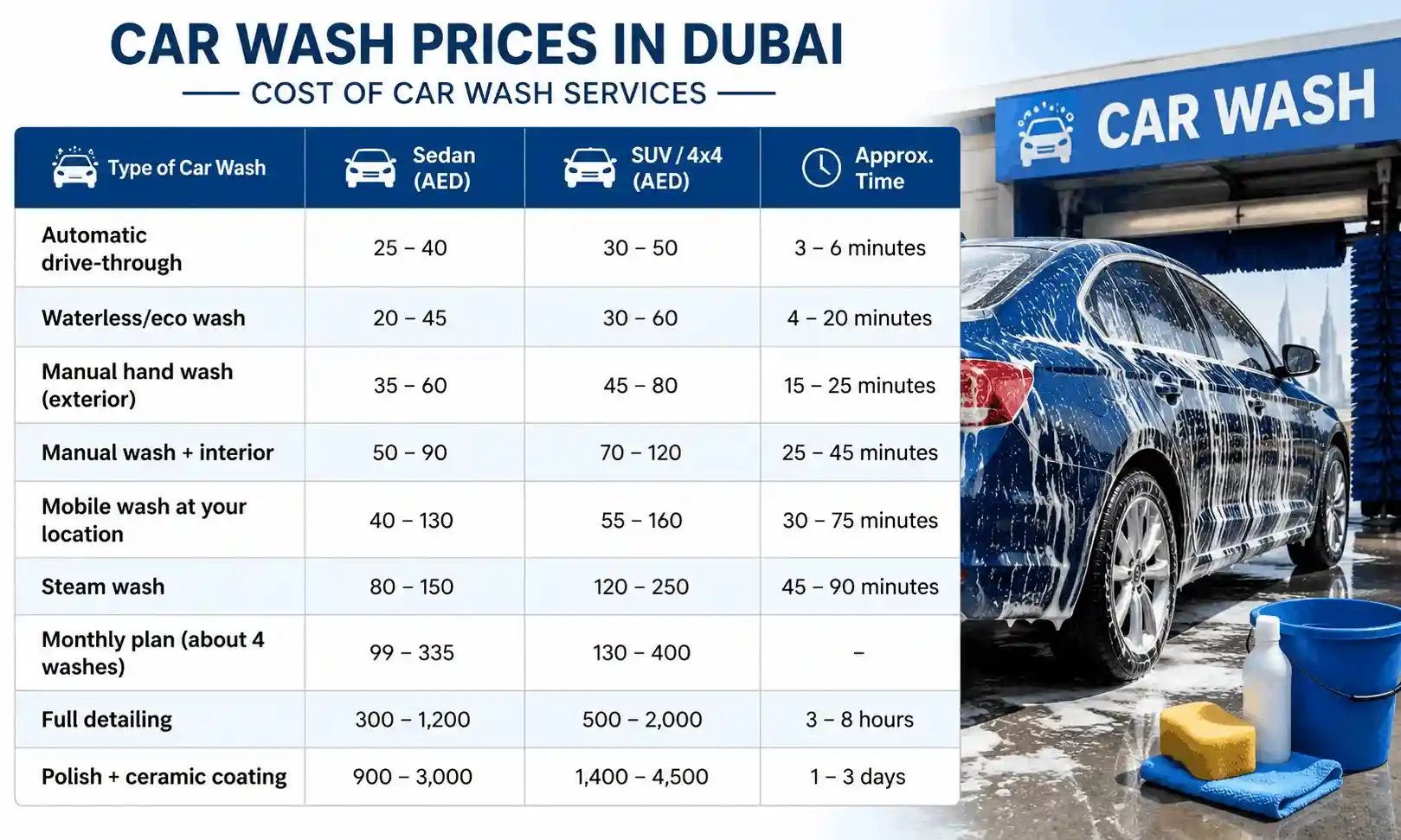 Last Updated : 17 Aug 2026Car Wash Prices in Dubai: Cost of Car Wash Services in 2026Check car wash prices in Dubai for 2026. Compare the cost of different car wash services, including mobile, steam, automatic, and detailing services.
 Last Updated : 17 Aug 2026ADNOC Car Wash in Dubai 2026 - Locations, Services Offer, Cost & MoreFind ADNOC car wash locations in Dubai, explore available services, prices, offers, and more. Check everything you need to know before visiting an ADNOC car wash.
 Last Updated : 04 Jun 2026How to Check Car Insurance Status Online in UAE - 2026Check Car Insurance Status Online - Checking your vehicle insurance status online in UAE with these methods RTA Website , EVG , MoI ,Policybazaar.ae & more.
- Last Updated : 31 Jul 202610 Best Car Insurance Companies in Dubai, UAE - 2026Checkout the list of top 10 best car insurance companies in Dubai, UAE with their products & service benefits that they offer so you can choose best as per your needs.
 Last Updated : 24 Mar 2026How to Transfer Vehicle Ownership in UAE - Process, Documents, FeesTransfer Car Ownership in UAE - Checkout Step by step guidance to transfer your car registration & ownership when you are selling or buy used cars in UAE
 Last Updated : 21 Jul 2026Abu Dhabi Traffic Fines 2026 - Complete List, Payment & MoreGet the updated list of Abu Dhabi traffic fines for 2026, including speeding fines, number plate violations, reckless driving penalties, and more. how to check and pay Abu Dhabi Police traffic fines online.
.jpg) Last Updated : 15 Jun 2026Abu Dhabi Parking SMS - Format, Codes, Types, Charges, How to PayGet the Comprehensive Guidance for SMS Parking in Abu Dhabi. Also know how to Pay for MAWAQIF Parking, Parking types and charges, Code List, Benefits, Extensions, & more about Abu Dhabi Parking SMS.
Last Updated : 15 Jun 2026Abu Dhabi Parking SMS - Format, Codes, Types, Charges, How to PayGet the Comprehensive Guidance for SMS Parking in Abu Dhabi. Also know how to Pay for MAWAQIF Parking, Parking types and charges, Code List, Benefits, Extensions, & more about Abu Dhabi Parking SMS. Last Updated : 19 Aug 2026How to Check Black Points on Your Licence in Dubai | 2026 GuideCheck black points on your Dubai driving licence online through Dubai Police, RTA,MOI UAE App, & more. Know the steps, required details, 24-point limit and penalties.




 Google Reviews